
The AI compute shortage is real. Nvidia can't ship GPUs fast enough. AWS and Google Cloud charge enterprise rates that small teams and researchers can't afford. The waitlist for H100 access at any major cloud provider has stretched into months.
Theta Network has been building the answer to this problem since 2018. The question in 2026 is whether the market is finally ready to pay attention.
Here's the full case.
What Decentralized GPU Actually Means
Let me start from the ground up.
A GPU is a graphics processing unit. It was originally built for rendering video game graphics. Researchers figured out it was also exceptionally good at the kind of parallel math that machine learning requires.
Now everyone wants GPUs. AI companies, researchers, video production studios, 3D rendering pipelines. Demand massively outstrips centralized supply.
Decentralized GPU computing means aggregating idle GPU capacity from thousands of individual machines around the world into a unified network. Instead of one company owning all the hardware, thousands of contributors lend their spare compute power and get paid for it.
The person with a gaming PC they only use six hours a day is sitting on compute that someone else would pay to access at 3am. That's the whole premise.
Theta Network: What It Actually Built
Theta launched in 2018 as a decentralized video streaming network. Users shared bandwidth and earned tokens for relaying video to other viewers.
That was the original pitch. The pivot happened gradually and became explicit by 2025.
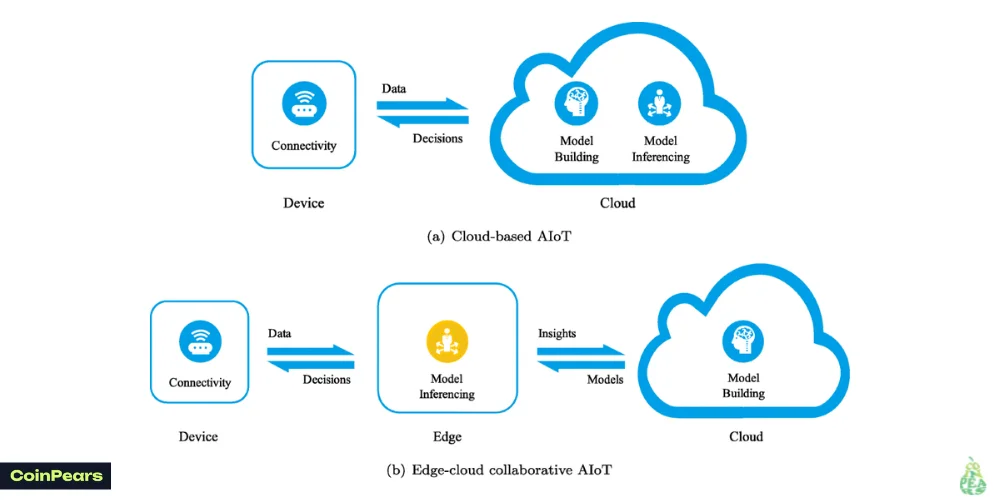
The insight was straightforward. The same distributed edge network that handles video streaming can handle AI inference workloads. Run AI models on community hardware instead of expensive centralized GPU clusters.
That pivot produced Theta EdgeCloud, launched in June 2025. It's the most important thing Theta has built and it's the entire reason to pay attention to this project right now.
What EdgeCloud Actually Does
EdgeCloud is Theta's decentralized GPU marketplace. Here's how it works in practice.
You have a gaming PC with a solid GPU sitting idle most of the day. You install Theta Edge Client, connect your machine to the network, and start earning TFUEL tokens for every compute task your GPU handles.
On the other side, a university research lab needs to train an AI model but doesn't have budget for AWS H100 instances at $15 per hour. They access EdgeCloud, pay in TFUEL, and get their compute done at a fraction of the centralized price.
The network intelligently routes workloads to the right hardware. Light inference tasks go to community consumer GPUs. Heavy training workloads requiring more power get routed to the enterprise GPU tier that includes NVIDIA H200s and A100s.
Over 30,000 edge nodes currently provide GPU capacity across the network. The combination of community hardware and enterprise-grade silicon in one marketplace is what EdgeCloud calls the hybrid architecture.
 The Enterprise Validator Story Nobody Is Talking About Enough
Here's the part that I think gets underappreciated in most Theta coverage.
The enterprise validator list includes Google, Samsung, Sony, Binance, Blockchain.com, and Deutsche Telekom. These companies run nodes that help secure the network.
Deutsche Telekom joined as an enterprise validator in October 2025. That's Europe's largest telecommunications company embedding Theta into its infrastructure strategy. Not a token sponsorship. An actual operational commitment.
Imperial College London became the first European academic partner in January 2026, using EdgeCloud for AI security research.
City St George's, University of London joined as the 34th university partner in May 2026.
The full academic list includes Stanford, Seoul National University, KAIST, University of Oregon, Michigan State, Yonsei University, Soongsil University, Peking University, and Emory University.
More than 20 world-class academic institutions running real AI research on this infrastructure. These are not marketing partnerships. These are institutions with serious computational requirements choosing Theta over AWS and Google Cloud for specific workloads.
The Two Tokens: THETA and TFUEL
Theta runs a two-token system. Understanding both is essential before any investment consideration.
THETA is the governance and staking token. Hard-capped at exactly one billion tokens. No more will ever be created. Used to run validator and guardian nodes. Staking THETA earns TFUEL rewards.
TFUEL is the operational gas token. Used for all on-chain transactions, EdgeCloud payments, smart contract execution, and video delivery. TFUEL has an initial annual inflation target of 5 percent issued as staking rewards. Countering that inflation, at least 25 percent of all Edge Network payments and 100 percent of gas fees are burned permanently.
The economic equation is this. If network usage generates enough TFUEL fees and burns to exceed the 5 percent inflation rate, TFUEL becomes deflationary. More usage means more burning means more scarcity.
Right now usage isn't generating enough burn to offset inflation. That's one of the honest challenges. But the mechanism is designed correctly if adoption scales.
Where THETA Sits Right Now: The Honest Numbers
THETA is trading at approximately $0.14 as of June 2026. The 24-hour trading volume sits around $8.8 million.
The all-time high was $15.90 in April 2021. Current price represents a 99 percent drawdown from that peak.
The market cap at current prices is tiny relative to the infrastructure being built. That's either the opportunity or the warning sign depending on how you read what comes next.
One significant development on the negative side: Binance delisted the TFUEL/BTC trading pair on May 1, 2025, citing low liquidity and volume. That directly impairs market depth for TFUEL specifically and makes the token harder to access for some retail participants.
There are also whistleblower lawsuits filed in December 2025 alleging fraud and market manipulation by Theta's CEO. These are unresolved as of June 2026 and represent a real credibility overhang that no honest analysis of Theta can ignore.
The EdgeCloud Adoption That Matters Most
Here's the 2026 roadmap execution that's actually happening.
EdgeCloud launched its Inference Engine integration with RapidAPI, giving instant access to over 3 million developers through a standard API. That's the largest single distribution channel the platform has ever had.
The network upgraded from NVIDIA H100 to H200 GPUs for training workloads. That's a meaningful performance jump for the academic and enterprise users who need heavy compute.
The Houston Rockets built ClutchBot, an AI-powered fan engagement mascot, on EdgeCloud infrastructure. The Philadelphia Union launched a new app powered by EdgeCloud. Multiple sports franchises are using real-time AI tooling built on decentralized GPU compute.
These are live deployments. Real products. Real users.
The honest frustration is that none of this is moving the price. The product is building real-world traction and the token is still 99 percent below its all-time high. That disconnect is the central question for anyone evaluating Theta in 2026.
Why the Price Isn't Moving Despite Real Adoption
Here's the thing that requires honest analysis rather than just hype.
TFUEL has persistent inflation at 5 percent annually. Until EdgeCloud usage generates enough fee burns to counteract that inflation, there's constant sell pressure from stakers receiving newly minted tokens.
The Binance TFUEL delisting reduced the market's ability to absorb buy pressure efficiently. Thinner liquidity means the same amount of buying force moves price less than it would on a deep order book.
The whistleblower lawsuit creates institutional hesitancy. Funds that might consider THETA as a DePIN infrastructure play are watching the legal situation before committing.
And the broader DePIN narrative, which stands for Decentralized Physical Infrastructure Networks, hasn't fully captured retail imagination the way pure meme coins and AI agent tokens have in this cycle. Theta is solving a real problem with real infrastructure but the market is rewarding narrative faster than it rewards substance.
The DePIN Comparison: Where Theta Sits
Theta is competing in the DePIN category alongside projects like Render Network, Akash Network, and io.net for decentralized GPU compute specifically.
Render has traditionally gotten more attention in the GPU compute space, particularly from the creative industry for 3D rendering. Akash is popular with developers for compute deployment. io.net has aggressively marketed its decentralized GPU cluster positioning.
What Theta has that most competitors don't is the enterprise validator network. Google and Deutsche Telekom running nodes is a credibility signal that most DePIN projects can't point to.
What Theta lacks compared to some competitors is narrative clarity. The history as a video streaming project sometimes confuses positioning. Is it media infrastructure? AI compute? Edge computing? The answer is all three, but multi-thesis positioning is harder to communicate in a market where simple stories win attention.
The Broader Context: Why Decentralized GPU Has a Real Future
Here's the macro argument that underlies any Theta investment thesis.
AI compute demand is growing faster than centralized supply can keep up with. NVIDIA's production constraints are a structural reality, not a temporary blip. The cost of running inference workloads on AWS or Google Cloud is prohibitive for smaller teams, individual researchers, and academic institutions in developing countries.
A marketplace that aggregates idle GPU capacity globally, prices it below centralized alternatives, and pays contributors in tokens creates genuine two-sided value. Contributors earn passive income from hardware they already own. Users get compute at lower cost than centralized alternatives.
This is not a speculative use case. The economic logic is sound. The question is execution and timing.
For crypto projects across the board, whether NFTs on Solana or DePIN infrastructure plays like Theta, the pattern is the same. Real utility and adoption are necessary but not sufficient for price appreciation. Narrative, timing, and liquidity depth all play roles that are as important as the underlying technology. We explored this dynamic recently in the Solana ecosystem context, and the same framework applies here. If you're thinking about how smaller and newer crypto projects build their case for value, the Solana Cyclopes breakdown covers that thought process in a completely different context but with the same underlying questions about adoption and timing.
The Bull Case in Plain Terms
If EdgeCloud achieves meaningful commercial scale, every transaction generates TFUEL fees, 25 percent of those fees get burned, and the burn rate eventually exceeds the 5 percent inflation. TFUEL becomes deflationary. THETA stakers earn more TFUEL as the network generates more activity.
The THETA hard cap at exactly one billion tokens means there's no supply creep on the governance token. As EdgeCloud demand grows, the incentive to stake THETA grows, reducing circulating supply and supporting price.
Deutsche Telekom, NTT Digital, and additional telecom validators in the H2 2026 roadmap represent potential enterprise compute distribution at a scale that would generate consistent daily TFUEL burns rather than the current sporadic pattern.
If the whistleblower case resolves without finding substance, that overhang clears and institutional capital that was waiting on the sidelines has a clearer path to entry.
Conservative 2026 price targets for THETA sit around $0.29 if EdgeCloud adoption continues. More optimistic models targeting $0.91 require broader market conditions turning bullish alongside continued EdgeCloud growth.
The Bear Case in Plain Terms
The whistleblower lawsuit could prove substantive. If governance and trust damage follows, the enterprise partnership story collapses.
TFUEL inflation continues to exceed burn rates, creating persistent sell pressure that suppresses price even as real usage grows.
Render Network, io.net, or a well-funded new entrant captures the DePIN GPU narrative more effectively and draws liquidity away from Theta's ecosystem.
The academic and sports use cases, while real, don't generate enough daily TFUEL volume to move the economic needle meaningfully. Theta builds a genuine product that the market simply prices as irrelevant.
My Honest Take
Theta is the most interesting DePIN project I've looked at in depth in 2026. The infrastructure is real. The partnerships are serious. The economic mechanism, if it achieves scale, is designed correctly.
The honest obstacles are real too. Legal overhang. Liquidity challenges after the Binance delisting. A narrative that doesn't fit neatly into one of the hot categories retail is chasing this cycle.
If you're evaluating a position, the risk profile is asymmetric in an interesting way. A very small market cap relative to the infrastructure being built, a hard-capped governance token, and enterprise validators that most crypto projects would give anything to have. Against that, legal uncertainty and a price that has shown no sign yet of reconnecting with the fundamental progress.
The thesis is long. The timeline is uncertain. Size accordingly.
FAQs
What is Theta Network's decentralized GPU platform?
Theta EdgeCloud is a hybrid GPU marketplace launched in June 2025 that combines community consumer GPUs with enterprise-grade NVIDIA hardware to provide AI compute at below-market prices.
What are THETA and TFUEL tokens?
THETA is the governance and staking token with a hard cap of one billion. TFUEL is the operational gas token used for all EdgeCloud payments and on-chain transactions.
Who uses Theta EdgeCloud in 2026?
Academic users include Stanford, Imperial College London, Seoul National University, and 30-plus universities. Enterprise users include NBA teams and MLS franchises for AI fan engagement tools.
Why is THETA price still low despite real adoption?
TFUEL inflation exceeds current burn rates, Binance delisted TFUEL/BTC reducing liquidity, and unresolved whistleblower lawsuits create institutional hesitancy despite genuine product progress.
What is the THETA price prediction for 2026?
Conservative models project $0.29 if EdgeCloud adoption continues. Optimistic models target $0.91 requiring both continued adoption and a broader crypto bull market.