
 Brain Lucas
Aztec (AZTEC) is a blockchain protocol and privacy infrastructure designed to enable confidential transactions and shielded financial activity on public blockchains—particularly Ethereum. At its core, Aztec uses advanced cryptographic techniques like zero-knowledge proofs (specifically zk-SNARKs) to encrypt transaction details while still allowing them to be validated by the network.
The Aztec Network aims to bring privacy-preserving features to decentralized finance (DeFi), enabling users to send, receive, and interact with digital assets without revealing amounts, balances, or transaction metadata to the public blockchain. This privacy model addresses growing concerns over transparency and financial exposure inherent in many public networks.
Aztec’s privacy solutions are smart contract-based, allowing integration with decentralized applications while preserving confidentiality where needed. The ecosystem includes both a native utility token (AZTEC) and privacy protocols utilized by developers building private DeFi and payment systems.
Exchanges
Aztec’s token (AZTEC) and related assets can be traded on several centralized and decentralized platforms.
Centralized Exchanges (CEX)
Binance – Offers AZTEC trading pairs
Coinbase Exchange – Lists Aztec assets depending on eligibility
KuCoin – Provides spot trading for AZTEC
Gate.io – Supports AZTEC trading with multiple pairs
These centralized exchanges list AZTEC with USD, USDT, or ETH trading pairs depending on region and platform.
Decentralized Exchanges (DEX)
Uniswap V3 – Commonly used for AZTEC/ETH and AZTEC/USDC swaps
SushiSwap – Supports liquidity pools for Aztec tokens
Balancer – Offers custom liquidity pools including shielded asset protocols
Liquidity and available pairs on DEXs depend on current pool contributions and network activity.
AZTEC Token Price
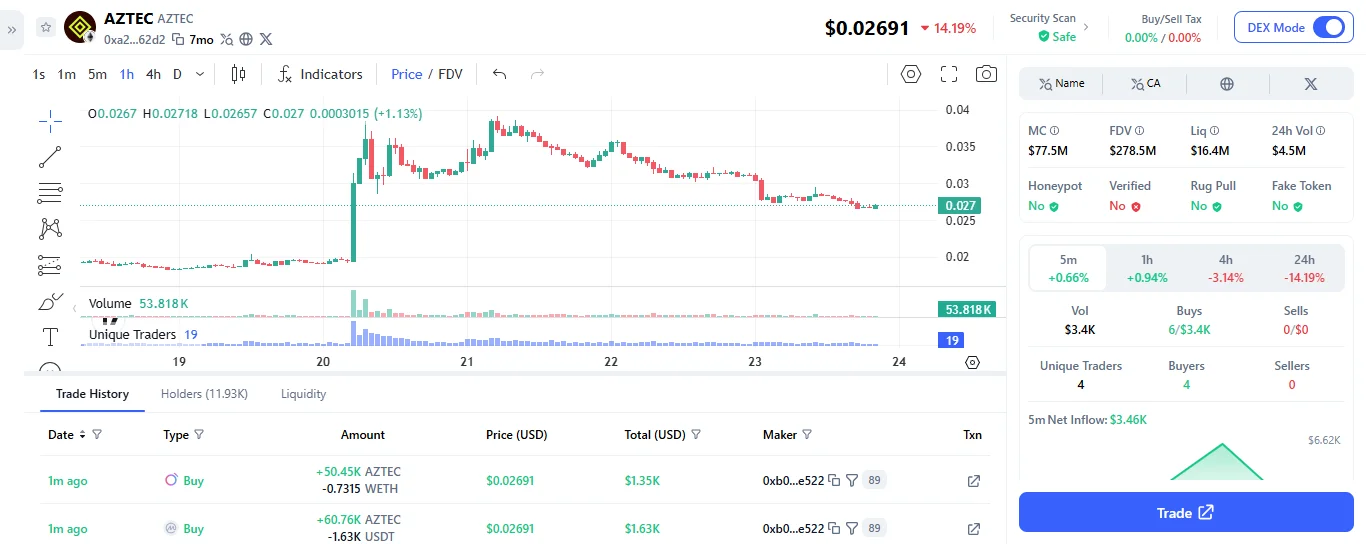
Live price data for AZTEC fluctuates across exchanges and trading pairs. As an example, AZTEC has previously traded at prices ranging from $0.20 to $1.20+ USD on key exchanges like Binance and Uniswap, depending on market conditions, time period, and liquidity levels.
Because AZTEC is listed on multiple venues with varying depth, the token’s price may show slight differences across platforms. Prices are driven by market sentiment, adoption of Aztec privacy solutions, broader DeFi trends, and news impacting zero-knowledge technology.
Market Stats
Key market statistics for Aztec include:
Token Symbol: AZTEC
Blockchain Networks: Ethereum-based (ERC-20)
Market Cap: Variable depending on circulating supply and price (data differs across trackers)
Contract Standard: ERC-20
Circulating Supply: Tracked on major aggregators (varies over time)
Max Supply: Subject to protocol emission rules (refer to official documentation)
Market cap and volume figures vary across aggregators and time frames.
Performance
Aztec’s performance reflects broader trends in privacy infrastructure and DeFi. The token’s value generally responds to innovations in zero-knowledge cryptography, interest in privacy solutions, and institutional concern about on-chain transparency. Price movements also correlate with general cryptocurrency market trends and regulatory discourse around privacy technologies.
Since privacy is a specialized niche within blockchain technology, AZTEC’s performance can diverge from major layer-1 or DeFi tokens, responding more directly to protocol upgrades, integrations, and adoption events.
Price Analysis
Price analysis for AZTEC incorporates various factors:
Adoption of privacy solutions by wallets and DeFi dApps
Announcements of protocol upgrades or zk-SNARK enhancements
Market sentiment toward privacy tech after regulatory news
Trading volume and liquidity depth on CEX and DEX platforms
Technical indicators such as RSI, MA, and volume trend lines provide insight on short-term movements, while macroeconomic conditions and blockchain privacy demand shape long-term outlook.
Recent Trends
Recent trends for Aztec include:
Implementation of enhanced zero-knowledge proof mechanisms
Integration with privacy-enabled bridges and Layer-2 services
Partnerships with DeFi protocols seeking confidential transaction layers
Increased interest from developers building private payment solutions
These trends highlight Aztec’s focus on expanding private transaction utility across the broader Ethereum ecosystem.
Market Details
Aztec operates with the following technical and ecosystem specifics:
Primary Network: Ethereum (Layer-1)
Privacy Infrastructure: Zero-knowledge proofs (zk-SNARKs)
Compatibility: Integrates with Ethereum wallets and DeFi platforms
Shielded Pools: Enable private asset transfers within public chains
Users can interact with Aztec protocols using wallets that support encrypted transactions and privacy overlays.
See Also: BREM (BREM)
Tokenomics
Aztec’s tokenomics structure is designed to support ecosystem growth and protocol utility:
Utility: Token is used for governance, staking incentives, and accessing privacy features
Emission Protocols: Defined through the network’s governance and reward mechanisms
Governance Participation: AZTEC holders may vote on protocol upgrades and privacy parameters
Exact tokenomics (distribution, allocation, vesting schedules) are defined in Aztec’s official documentation and updated through governance proposals.
Price History
Aztec’s token price history demonstrates cycles of volatility consistent with emerging blockchain sectors. Initial trading periods showed strong momentum following exchange listings, followed by consolidation phases as the privacy sector matured.
Historical data from aggregators reflects AZTEC’s varied performance amid shifting sentiment in DeFi and broader crypto markets.
 Pros and Cons
Pros:
Strong focus on privacy infrastructure using advanced cryptography
Compatible with Ethereum DeFi ecosystem
Listed on major centralized and decentralized exchanges
Applicable to shielded transactions and confidential DeFi use cases
Cons:
Niche demand compared to mainstream DeFi or NFT tokens
Price and volume influenced heavily by privacy tech adoption
Regulatory uncertainty around privacy-enabled blockchains
Requires technical understanding to fully leverage privacy features
FAQs
Where can I buy AZTEC?
AZTEC can be purchased on centralized exchanges like Binance, KuCoin, Gate.io, and decentralized exchanges like Uniswap and SushiSwap.
What blockchain does Aztec use?
Aztec is built on the Ethereum network and uses ERC-20 tokens with privacy protocol overlays.
Is AZTEC a good investment?
Investment decisions depend on personal risk tolerance. Privacy infrastructure offers long-term utility, but regulatory and market volatility risks should be considered.
What is Aztec used for?
Aztec is used to enable privacy-preserving transactions, shielded transfers, and participation in privacy-focused DeFi environments.
Can AZTEC token be staked?
Depending on platform support, AZTEC may be used in staking or governance programs within its ecosystem.