
When people ask “Is XRP the next Bitcoin?” they are really asking whether XRP could match or surpass Bitcoin in popularity, value, or influence. The short answer: it depends on what “next” means.
XRP and Bitcoin serve different purposes one emphasizes fast payments and utility, the other scarcity and store-of-value. But under certain conditions, XRP could attract more attention and use.
This article explores both sides where XRP shines and where it trails helping you form an informed view.
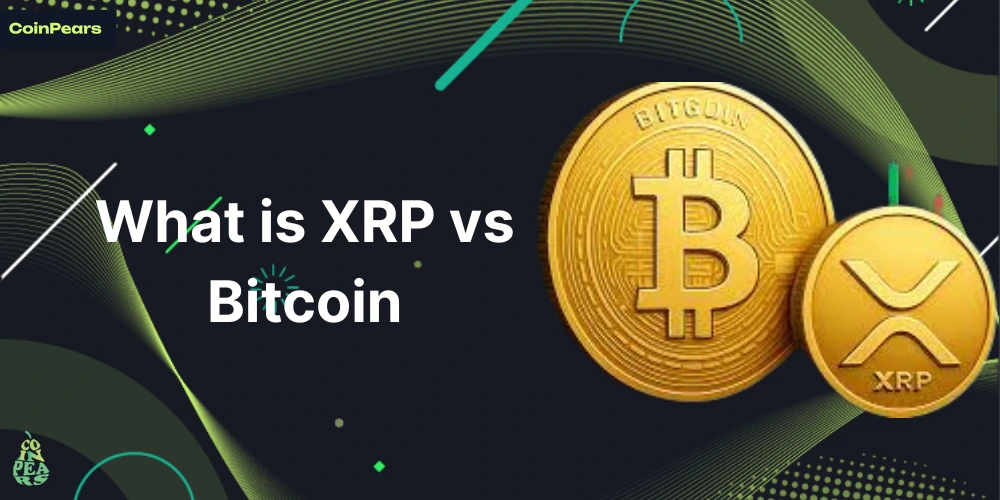
What is XRP vs Bitcoin?
Bitcoin and XRP are two major cryptocurrencies with distinct purposes, technologies, and mechanisms.
Bitcoin (2009) is a decentralized coin using mining and PoW for peer-to-peer transactions, aiming for value preservation, decentralization, and censorship resistance. XRP (2012, XRPL) focuses on fast, low-cost cross-border payments for banks, emphasizing speed and real-world utility.
Bitcoin uses proof-of-work (PoW), where miners solve cryptographic puzzles to validate transactions and secure the network. XRP uses a consensus protocol with trusted validators, no mining required, to confirm transactions quickly and efficiently.
Bitcoin transactions can take minutes or longer during high demand, with substantial fees. XRP transactions settle in 3–5 seconds with minimal fees, making them much cheaper.
Bitcoin struggles with throughput under heavy load, limiting everyday transactions. The XRPL handles many more transactions per second, supporting higher network throughput.
Bitcoin has a hard cap of 21 million coins, supporting its store-of-value narrative. XRP was pre-mined with 100 billion tokens, some held by creators and periodically released, affecting distribution and liquidity.
 Use Cases: What each is best for
Bitcoin is store of value and long‑term investment. Because of its scarcity, decentralized and permissionless design, Bitcoin has become “digital gold.”
Many treat it as a hedge against inflation or store of value over the long haul. It appeals to investors who value security, censorship resistance, and decentralization over transactional utility.
Moreover, institutional adoption ETFs, large holders, growing global recognition reinforces its position as the flagship crypto asset.
XRP excels at fast, low-cost money transfers, with rapid settlement and minimal fees. It’s ideal for remittances, cross-border payments, currency liquidity bridges, and bank/payment systems.
For users or institutions needing to send smaller amounts frequently, or sending amounts across borders where fees and speed matter, XRP can beat Bitcoin hands-down.
Its design really addresses the real-world inefficiencies of traditional banking systems when it comes to global money transfer.
Also, XRPL supports additional functionalities: beyond simple transfers, it allows tokenization of assets, stablecoins, even decentralized exchange functions making its use case somewhat broader than just payments
Where XRP Cannot Replace Bitcoin: The Challenges
While XRP excels at fast, low-cost transactions, it cannot fully replace Bitcoin due to several challenges.
Bitcoin’s strength lies in its robust decentralization: its permissionless network allows anyone to run a node, mine, or verify transactions, providing strong censorship resistance and security.
XRP’s consensus is fast and efficient, but limited validators reduce decentralization. Large holdings by founders and institutions may affect security and network control.
In terms of adoption and market position, Bitcoin leads in brand recognition, institutional backing, and perceived store-of-value, remaining the preferred choice for many investors as of 2025.
XRP, while useful for real-world payments, has yet to match Bitcoin’s global trust or mainstream investment adoption, relying heavily on uptake by banks and payment providers.
XRP has use-case limits: its large supply and token release model reduce suitability as a store of value, and high-volume or institutional finance may challenge the XRPL’s architecture.
Moreover, although XRPL supports tokenization and other functionalities, these ecosystems are still developing, and widespread adoption is not guaranteed.
Read Also: XRP Price Prediction After Lawsuit, What Happens Next?
Real-World Adoption: XRP in Action
A key factor in assessing whether XRP the next Bitcoin” is its real-world adoption.
Unlike Bitcoin, a store-of-value, XRP focuses on payments and banking. Institutions and remittance companies use XRP/XRPL for cross-border transactions, improving liquidity, reducing costs, and speeding settlements.
RippleNet connects hundreds of institutions for fast, cost-effective transfers, though mass adoption relies on regulatory clarity, strong partnerships, and network trust.
While Bitcoin remains dominant as digital gold, XRP is carving a niche in payments, serving a complementary role rather than directly competing, with steadily growing practical utility in the crypto ecosystem
Is XRP the Next Bitcoin?
Is XRP the next Bitcoin? To make this shift from a fast payments coin to a major store-of-value, several factors are needed.
Broader global adoption is crucial not just by crypto users, but by banks, remittance services, fintechs, and international businesses; if XRPL becomes a common backbone for global money movement, demand for XRP could rise.
Confidence and trust in its decentralization and security are also essential, with transparent governance and validator distribution helping build credibility.
Price stability and liquidity are required for long-term investors to view XRP as “digital gold,” meaning predictable supply dynamics and token release schedules.
Regulatory clarity would further support adoption, as uncertainty can limit both institutional and retail interest.
Finally, ecosystem growth beyond payments including tokenized assets, stablecoins, decentralized finance, global remittances, and potentially smart contracts would broaden its use case.
If these factors align, XRP could challenge Bitcoin’s dominance, especially for users and institutions seeking speed, affordability, and real-world utility.
Where Many Experts & Critics Place Their Bets: A Balanced View
Where do experts and critics place their bets? XRP excels in speed, cost, scalability, and efficiency, making it a strong choice for payments and everyday transfers.
Bitcoin, on the other hand, remains the most decentralized, secure, and scarce cryptocurrency, making it better suited as a long-term store of value and investment.
Many analysts emphasize that it’s not about one replacing the other they serve different roles: Bitcoin as “digital gold” and XRP as “digital payments rails.”
One assessment sums it up: “Bitcoin dominates as digital gold; XRP excels in cross-border payments.”
Ultimately, what matters depends on your goals: investment return, store-of-value, daily payments, or global remittance.
Final Thoughts
The question “Is XRP the next Bitcoin?” has no simple answer, as they serve distinct purposes.
Bitcoin remains the most trusted store-of-value, while XRP excels in fast, low-cost payments and cross-border transactions.
XRP could grow in adoption among banks, remittance services, and fintechs, but faces challenges in decentralization, perception, and regulation.
Rather than replacing Bitcoin, XRP may complement it as a payments-focused counterpart, while Bitcoin stays digital gold.
For investors, the choice depends on valuing long-term security versus transactional utility, with careful attention to adoption trends and market developments.
Frequently Asked Questions
What makes XRP different from Bitcoin?
XRP is designed for fast, low-cost payments and cross-border transfers, while Bitcoin is mainly a store-of-value with strong decentralization and scarcity features.
Can XRP reach the same value as Bitcoin?
It’s uncertain. XRP could rise in value if adoption increases, but it’s unlikely to match Bitcoin’s market dominance in the short term due to Bitcoin’s established reputation and scarcity.
Is XRP a good investment?
XRP can be a good choice for those looking at transactional utility or potential growth in financial systems. Investors seeking long-term store-of-value may prefer Bitcoin.
How fast are XRP transactions compared to Bitcoin?
XRP transactions usually settle in 3–5 seconds, whereas Bitcoin transactions can take minutes to hours depending on network congestion.
Does XRP face regulatory challenges?
Yes, XRP has faced regulatory scrutiny in some countries, especially regarding its classification as a security. Regulatory clarity is essential for its long-term adoption.
Is XRP the next Bitcoin?
XRP is unlikely to replace Bitcoin entirely. Instead, it can complement Bitcoin by serving as a fast and efficient payments network, while Bitcoin retains its role as a store-of-value.
Is XRP decentralized like Bitcoin?
Not fully. XRP uses a consensus protocol with trusted validators, which is faster but less decentralized than Bitcoin’s mining-based system.
Should I invest in both XRP and Bitcoin?
Many experts suggest diversifying between cryptocurrencies. Bitcoin offers security and store-of-value potential, while XRP provides utility and faster transactions, covering different aspects of the crypto market.