
 Brain Lucas
Espresso (ticker: ESP) is a decentralized blockchain infrastructure project designed as a shared sequencing, coordination, and finality layer for Ethereum rollups and Layer-2 blockchain ecosystems. The network aims to address fragmentation in multi-chain environments by providing a neutral sequencing layer that enables fast transaction finality, seamless cross-chain interactions, and scalable data availability across multiple rollup chains.
Espresso’s architecture is built around the HotShot BFT (Byzantine Fault-Tolerant) consensus protocol and a Tiramisu data availability layer, enabling block finality in seconds rather than minutes. The project seeks to unify liquidity and interoperability for rollups and app-specific chains without executing individual transactions itself.
The ESP token is the native utility and staking asset used to secure the network, participate in governance, pay protocol fees, and incentivize long-term ecosystem engagement. The network has secured substantial funding and institutional backing as part of its expansion into modular blockchain infrastructure.
Exchanges
Centralized Exchanges (CEX)
MEXC – Lists ESP for spot trading, including initial rollout support
KuCoin – Supported spot trading since ESP launch
BingX – ESP/USDT trading with promotional zero-fee period
BitMart – Spot trading available for ESP
Phemex – Announced ESP spot listing starting Feb 23, 2026
These exchanges provide primary venues for trading ESP with major pairs like ESP/USDT and others.
Decentralized Exchanges (DEX)
Because ESP is an ERC-20 token compatible with Ethereum, it may also be tradable via liquidity pools on decentralized exchanges such as:
Uniswap V3
SushiSwap
Balancer
Availability on DEXs depends on active liquidity pools provided by users and market participants.
ESP Token Price
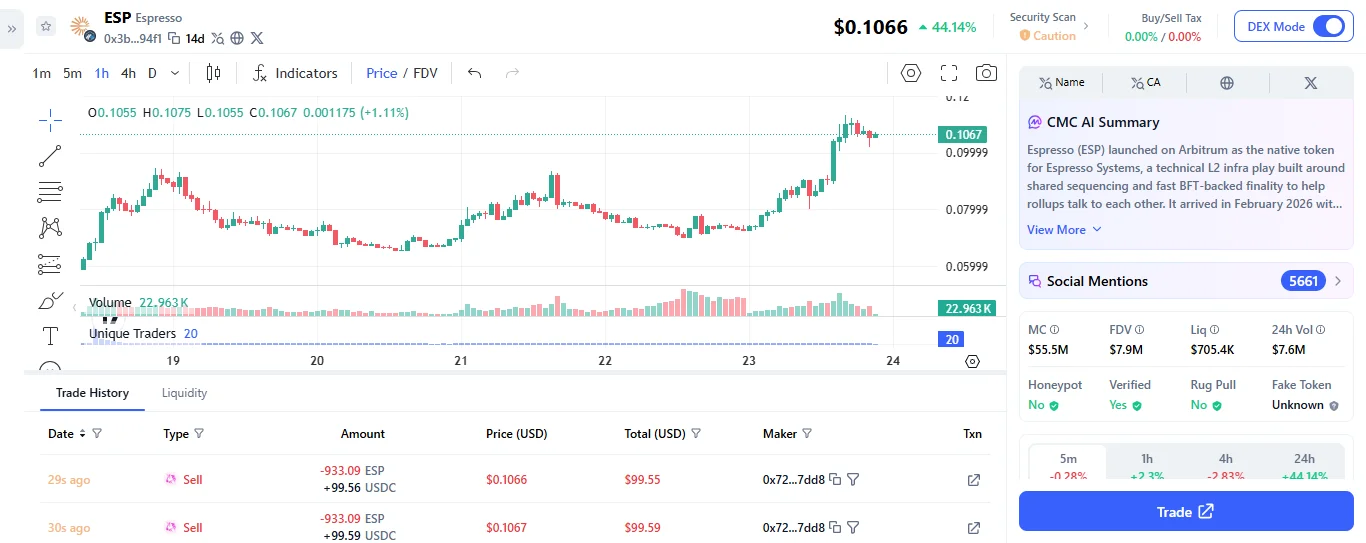
Based on live market data from price aggregators, the current price of ESP is approximately $0.0578 USD per token. The token’s 24-hour trading volume is around $47 million USD, with a circulating supply of about 520,550,000 ESP. The market cap is near $30 million USD, and the fully diluted valuation (FDV) is estimated at roughly $207 million USD.
Recent price performance shows ESP trading between daily lows near $0.0526 USD and highs around $0.0641 USD, with its all-time high recorded near $0.08718 USD.
Market Stats
Current market statistics for ESP include:
Current Price: ~$0.05783 USD
24-Hour Trading Volume: ~$47,465,154 USD
Market Capitalization: ~$30,104,020 USD
Circulating Supply: ~520,550,000 ESP
Total Supply: 3,590,000,000 ESP
Max Supply: Unlimited (no fixed cap)
These figures demonstrate ESP’s market footprint as an emerging Layer-1 infrastructure token with active trading activity.
Performance
ESP’s performance has shown volatility typical of newly launched infrastructure tokens. Its price responds to broader crypto market sentiment, exchange listings, liquidity influx, and network adoption events. The launch period following major exchange listings (such as MEXC, BingX, and BitMart) generated significant trading activity, which influenced short-term price movements.
Price Analysis
Technical price analysis for ESP should consider:
Market sentiment around Layer-2 and modular blockchain adoption
Participation and staking activity within the Espresso ecosystem
Liquidity levels across both centralized and decentralized venues
Broader crypto macroeconomic trends that impact altcoin performance
Early listings often create heightened volatility, and ESP’s lack of a maximum supply means long-term price behavior may be influenced by ongoing staking rewards and network emissions.
Recent Trends
Recent trends around ESP include:
Launch of the native ESP token with a 10% community airdrop to over one million eligible addresses
Transition to a permissionless proof-of-stake blockchain supporting decentralized sequencing and coordination
Integration focus for multi-chain interoperability with rollups such as Arbitrum, Polygon, RARI Chain, and others
Expansion of exchange listings and liquidity programs across major CEX platforms
These trends indicate growing interest in the Espresso infrastructure and its role in a modular blockchain ecosystem.
Market Details
ESP and the Espresso Network operate with the following characteristics:
Blockchain Network: Ethereum (ERC-20 compatibility)
Protocol Type: Layer-1 decentralized sequencing and coordination layer
Consensus Mechanism: HotShot BFT proof-of-stake
Primary Utility: Staking, governance, protocol fees, network security
Cross-Chain Support: Enables fast interoperability among multiple rollups and app chains
 Tokenomics
ESP tokenomics include:
Total Supply: 3.59 billion ESP
Circulating Supply: ~520,550,000 ESP
Max Supply: Unlimited (no hard cap)
Airdrop Distribution: 10% initial allocation to community via Holder Score model
Staking Rewards: Ongoing incentives designed to secure the network
Governance: ESP holders can participate in protocol governance decisions
This tokenomic model balances incentive distribution, decentralized security, and network growth.
See Also: AZTEC (AZTEC) Network
Price History
ESP’s price history since launch shows:
All-Time High: ~$0.08718 USD
All-Time Low: ~$0.05219 USD
Ongoing price fluctuations aligned with exchange listings and liquidity events
Pros and Cons
Pros:
Designed for fast finality and cross-chain interoperability
Strong institutional backing and ecosystem integrations
Active listings on multiple major exchanges
Staking and governance utility with community airdrop incentives
Cons:
No fixed maximum supply (potential inflation risk)
Price volatility typical of new infrastructure tokens
Dependency on rollup adoption and modular blockchain growth
Liquidity may vary across exchanges and time periods
FAQs
Where can I buy ESP?
ESP is available on centralized exchanges such as MEXC, KuCoin, BingX, BitMart, and Phemex, with trading pairs like ESP/USDT.
How much is ESP worth?
ESP currently trades around $0.05783 USD with significant 24-hour volume and a market cap of about $30 million USD.
What blockchain does Espresso use?
Espresso is built on a base layer designed for rollups with an ERC-20 token compatible with Ethereum.
Is ESP a good investment?
ESP carries both infrastructure utility and market volatility. Investment suitability depends on individual risk tolerance and long-term interest in modular blockchain adoption.
What is the ESP token used for?
ESP secures the network via staking, pays protocol fees, and enables participation in governance and shared sequencing operations.